In this 8th and final session, I make sure M&M leave with a sound
plan-of-action they can implement without me; that they have
a strategy for “launch.”
I help to take them from where they are right now—with a com-
pletely designed signature program and solid marketing strategies
–to the day they deliver their program. We create a “count-down”
to the event, and I cover everything from what to say to referral
partners to inspire them to spread the word about the program, to
what to say to get speaking engagements at churches and schools….
to the all-important, and always over-looked, math exercise to
determine how many people they need in their room to break-even,
make a profit, and have a healthy conversion into their next program.
A similar countdown is in chapter 11 of Speak Free and Profit (that
ebook you see on the right-hand side of the page), and it is very
detailed, but I’ll share what I had M&M do so you see how meticu-
lous you need to get. What do they do with all of the Touch Point
1 contacts I had them collect? They need to reach out to them
to see if they’re open to hosting M&M or referring them. I make
M&M write down all of the dates when they will make those calls.
Then they must mail the letter of introduction I wrote for churches
and schools.
Next (and promptly), in order to have something tangible to give
to these contacts, they must take the copy I wrote for them for
their promotional postcard and get it designed by a graphic
designer or Vistaprint, or Overnightprints. I make them put
the date in their calendar when they will send the copy to the
designer and when they’ll have the postcards in their hands.
Then, when will they go networking? They have just 3-4 months
to promote, and in that time, they need to saturate the market
with their presence and promotional material. And when will they
do their “video promotion” day, when they interview couples on
the street?
Next…how will they secure registrations? They need to add an
autoresponder to their technology, and have a page on their
website just for registrations. Even before that, they need to
secure a hotel, or the venue where they will host their seminar.
Again, I ensure that they write all of this down in their calendar
because I won’t be with them to provide accountability.
Very important, they need to carve out lots of time to practice.
And in order to deliver the “offer-from-stage,” they need to have
fleshed out the details of their next program (the 1-Day). So, when
are they going to sit down and design that program? They also need
to create a hand-out for their offer-from-stage—an order and/or
description form for the audience to hold while M tells them
about the 1-Day program.
Sound overwhelming? Sound like you don’t want to bother with
so much work? Well, M&M have each other to lighten the load, and
you can certainly hire someone to help you—but even if you work
alone, just taking one step at a time and putting each step into
your calendar are the keys to a smooth transition. Then, before
you know it, you’re on that stage, sharing the message and the solution
your market so desperately needs—and you look back at the stream
of things you did to get there, the frustration you experienced and
the pitfalls–and they all fade into the background. You are offering
an invaluable service, sharing your heart and your wisdom—helping
transform an audience—while you also make far more money than
you would working one-on-one. It’s well worth every step.
And M&M feel that way as we say good-bye. It’s been a steep incline
for them, doing things they’d never done before—and at warp speed,
no less: eight sessions in just one month. As we wind-down our last call,
the female “M” says to me, after much acknowledgment, “We need a
break from you, girl!” I laugh. “Those are the sweetest words I’ve ever
heard. It means I did my job.” She responds, “You did your job
exceedingly and in abundance!”
Truly, I couldn’t ask for more.
I hope you enjoyed this 8-day blog series! And if you ever need
me to help you with your signature program, I’m here!
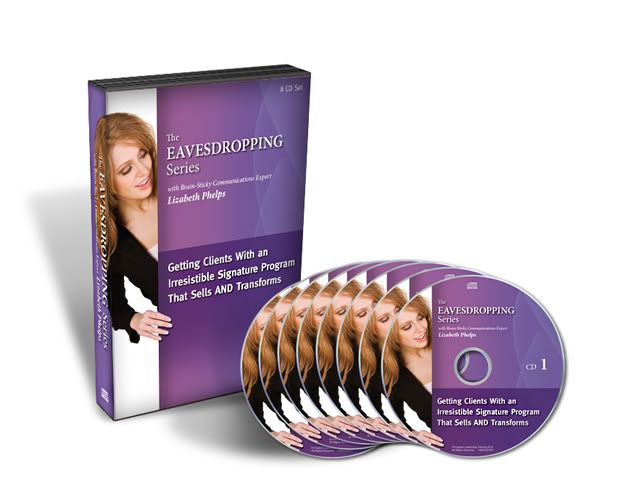
And you know that everything I did with M&M is available for
you in an 8 CD-Set, Getting Clients with an Irresistible
Signature Program that Sells AND Transforms, right?
I’m very excited to be able to offer that to you. Go see the
videos and grab your copy by clicking here!
To help M&M see this, I take them through another psychological
exercise for determining the VALUE of their program—so they see
that whatever price they offer for this 1-day is a steal…because
the seminar is so immensely valuable. Too many people “price” the
wrong way; they start with a price they believe the market can bear,
instead of starting with the value their market will get from their
expertise. So, we do this together: enumerate all that the young
couples will be saved from by attending this full-day program.
There is a lot of juicy information about selling and pricing in the
last quarter of this session.
And today you can hear it all! Today this 8-CD set goes on sale!
I’m so excited. Be sure to watch Video #2
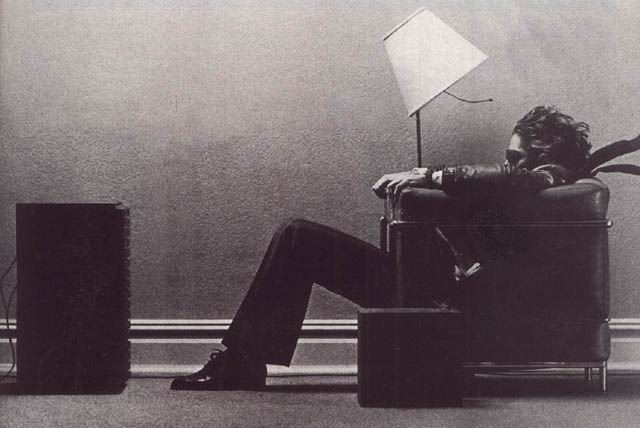
By the end of the 5th session, M&M no doubt feel a little
like this guy. One of them says to me, “I can hardly wait
for the next session!” with a little more than a touch of
sarcasm. I can be highly creative, but I can also be meti-
culously analytical, and this is the session where that side
of me comes out in spades! I lead them step-by-step through
a detailed discussion of how to market their signature portal
seminar.
They want to penetrate a local, not national, market, so we
explore an entirely local strategy—yet this session will
stimulate your marketing juices, even if you are doing on-
line marketing. So the question we answer in this session
is, “What are all the ways you’re going to reach your
market?”
We list all Touch-Point 1 venues again–churches, Rotary Clubs
and other affinity groups, schools and referral partners, and then
(and this is where it got painstakingly detailed), we moved through
every step in the communication process with each venue.
What does the initial outreach look like for most of them? Usually,
it’s calling to ask what form of contact they prefer: letter, brief face-
to-face appointment, phone call, email? They would do this with
referral partners and the places where they would actually give
their seminar. Then, we look at every communication piece
they will need, from letters of introduction, to a phone script, to
leave-behinds such as fliers or postcards. They’ll need something
for their referral partners (marriage counselors) to hand out to their
clients about the signature program, and they’d need something
to hand churches, schools and affinity groups that would describe
the event and its benefit to them.
This may all seem common sense, but I tell you, very few people
subject their marketing to such microscopic analysis until it’s
right upon them, and then they become overwhelmed. M&M may
feel blown away with all the initial footwork and planning that’s
entailed in formulating all of the promotional communication,
but it’s better to be overwhelmed with lots of time on your hands
than with very little–which is the case for most.
We also talk about networking options for them, such as
Once the couple moves through this transformation tool,
they can never go back to the Feast or Famine Communi-
cation Cycle. They’ve been changed forever. Armed
now with tools for changing how they communicate, their
couples are ready to look at the next cause of their financial
struggles: budgeting and reducing debt.
Believe it or not, we accomplish the design of their program
quite quickly in this session (I’ve had tons of experience!)
and move on to some very practical issues, namely how to
“repurpose” the teaching concept in this portal
program. “This teaching should be in everything you do,”
I tell M&M. Breaking the Secret Cycle of Financial Breakdown
should be the topic of their opt-in report, what their
In my third session with M&M, we delve very specifically
into the topic for their “portal,” signature program. In order
for this seminar to be Brain-Sticky, it must solve their market’s
biggest problem—based on our work on their “Trigger Event.”
The couples M&M serve, and want to serve more, bring in a
decent income; income is not their problem. Their problem is
that despite good income, they keep coming up short every
month. They have nothing to show for the hard work and
respectable salary. And from the Trigger Event exercise, we
realize that the husband most commonly blames the wife
for spending too much each month. He’s said it before, but
is never heard. The wife believes wholeheartedly that what
she purchases is necessary. Then, we uncovered that perhaps
the husband is making purchases that aren’t showing up on
the credit card—secret purchases.
I ask M&M, what is the bottleneck problem? If
I am also pleased to see that they have a target market!
I can’t tell you how many service entrepreneurs don’t.
“Couples” is still too broad, but we can begin to focus this
down by looking at the age of their market’s children. Do
M&M work with very new couples, who have newborns?
Or those who have preschoolers? Or are they in high school,
facing the issue of college? Each “era” has its own difficulties
and it is critical to know which difficulty they want to
address as coaches. They tell me that most of their clients
have children in elementary-school, indicating that (generally),
the parents have been married at least seven years, and up
to 14 years. These are often pressure-cooker times, when
the honeymoon is over, financial issues are no longer
ignorable and volcanic eruptions occur.
I begin to take M&M through a process I call the “Trigger
Event.” The fact is, humans walk around thinking they can
handle most of their issues by themselves, or at least with
the help of friends and family. But something happens, one
day—in fact, one moment—that triggers their dawning reali-
zation that they need help. This is a tough exercise for most
people, and M&M and I move right in like “Google Earth” on
their couples, looking in on a typical scene when such an
awakening might occur. They decide the couple is reviewing
a new credit card statement and we move through the entire
scene: what the conversation is like, what eruption occurs,
and what finally “pops the cork;” has one or both of them
blurting out, “We can’t do this alone!”
Why is this important to know? For starters, it is critical
to understand that you won’t make money if your market
isn’t hungry—and they aren’t always hungry. I always tell
my clients and students that your greatest competition is
not someone else, but rather the idea, “I can do this myself.”
But there will be a tipping point when they are in such pain
or frustration they are finally ready to spend money. And
you want to know what that pain is—on a very specific level
—so you can refer to it in marketing copy, creating intimacy
with your market as they “self-identify,” saying, “That’s me!”
—and so you can potentially influence that trigger event in
those who haven’t had it yet. The trials and tribulations are
there in the background, like a humming furnace, but they
haven’t realized they need help yet. You can help them
realize it, by talking about those moments, only if you know
what they are.
So, what is a moment that would wake up your market
from enduring and tolerating whatever is not working for
them? Would love to hear your ideas below! And be sure
to come back tomorrow, when M&M decide on the strategy
they’re going to use to get more clients!
The service entrepreneurs I work with—coaches, healers
nutritionists, consultants, therapists–love to perform their
services, but they also love to inform: so they speak
or give seminars. But often, what they’re speaking about
has no “through-line.” I just had coffee with a wonderful
new friend last week, who reminded me of this term.
A “through-line” is a theater term that means, “the
theme that runs through the plot of a film or other
dramatic work.” I would say it’s fitting to consider
businesses “dramatic work,” and so we want a “theme
that runs through the plot of our businesses.” And when
we’re giving a seminar or even a single presentation,
we want to ensure that it is inside of the through-line,
promoting that theme, reinforcing it, growing it. But
again, too many presentations and seminars are “isolated
incidences” that have no roots to a larger theme.
I am one week into my intensive program, 12 Sentences:
Ultimate Business Creation and Articulation, and the
participants are soon going to be considering their
business’s theme, so that everything they do—from
the articles they write to the opt-in gifts they offer to
their blog content…to the presentations they give—
runs through the “spine” (another word for through-
line) of their business.
Next week, I’m going to be launching my first CD set!
SO excited about that! And as you will see in the videos
I’ll be releasing about it next Tuesday, one of the many
things I did with two financial coaches was help them
develop their “teaching concept” for the free seminar
they would be giving to attract more clients. By teaching
concept, I mean the main premise of that signature
program. This teaching concept soon became their
“brand concept”—the premise or idea they were putting
forth not just in their free signature program, but the
premise or idea that supported their business and that
they would teach everywhere.
This teaching concept would be threaded through
the free report, ebook or video training for their opt-in;
it would be what they’d teach about in their articles,
and emphasize in their blog posts. It would be the subject
of radio interviews, local promotions and even a book,
should they choose to write one. I began referring to this
as their “brand concept.” The teaching concept “theme
running through the plot of their business.” It was created
as we developed the teaching premise of their signature
program, and then bloomed into the brand concept of their
entire business.
So, how do you know if you have a “brand concept”—or
even a teaching concept for your presentations? Well, let’s
start at the very beginning. Ask yourself this first, “Does
my presentation have a through-line, a theme that runs
through the plot of my business, or is it a tactical device,
a one-time talk I’m just ‘throwing together,’ with no strategic
roots”?
Next, “If I were to have a signature program—a free or
even paid event that people know me for—what is the
single concept I would teach in it?” (We won’t even consider
right now if it’s Brain-Sticky or not. Just consider the single
idea you would teach.)
And from there, ask yourself, “Could I teach this every-
where, in all of my marketing pieces, and feel that I was
teaching the most salient information out of everything
I could teach?” In other words, is this single idea the most
important and interesting I could put forth?
These are some ideas to get you started. But be sure to
register above in Blog Telecalls, for this week’s free
call at 1pm Thursday Oct. 7, where we’ll discuss this idea,
and I’ll share with you my signature program teaching concepts.
And stay tuned for the release of my 8-CD set next week,
the first in my Eavesdropping Series: How to Get Clients
with a Signature Program that Sells AND Transforms!